

Capybaras are some of the most fascinating animals you can find in South America. Many people see their gentle faces and wonder, “Are capybaras mammals? ” The answer is simple, but the details behind it reveal a world of interesting facts about these unique creatures.
If you want to understand what makes capybaras special, and why they are classified as mammals, you are in the right place.
What Makes A Mammal?
To answer if capybaras are mammals, we should first know what a mammal is. All mammals share a few key features:
- Warm-blooded: Mammals keep their body temperature stable.
- Hair or fur: Every mammal has hair at some point in its life.
- Live birth: Most mammals give birth to live young (except a few like the platypus).
- Milk production: Mammal mothers feed their babies with milk from special glands.
Capybaras check all these boxes. They have fur, are warm-blooded, give birth to live young, and mothers nurse their babies with milk. This proves, without doubt, capybaras are indeed mammals.
Capybara Basics
Capybaras are not just mammals; they are the largest rodents in the world. An adult capybara can reach up to 66 kg (145 lbs) and measure about 1.2 meters (4 feet) long. Their appearance is a mix between a guinea pig and a small hippo.
They live in groups and love water. You will often see them swimming or resting near rivers and lakes. Their webbed feet help them move easily in the water.
Capybara Classification
Let’s look at where capybaras fit in the animal kingdom:
| Classification Level | Capybara |
|---|---|
| Kingdom | Animalia |
| Phylum | Chordata |
| Class | Mammalia |
| Order | Rodentia |
| Family | Caviidae |
| Genus | Hydrochoerus |
| Species | H. hydrochaeris |
You can see “Mammalia” in the class row. This means capybaras are true mammals by scientific classification.

Credit: rescatewildlife.org
Unique Features Of Capybaras
Capybaras have some traits you will not find in many other mammals. Here are a few:
- Semi-aquatic lifestyle: Capybaras spend much time in the water to stay cool and escape predators.
- Social animals: They live in groups of 10–20, sometimes even 100 during the dry season.
- Herbivores: Their diet is 100% plant-based. They eat grasses, aquatic plants, and fruits.
- Webbed feet: Their toes are connected, making them excellent swimmers.
- Teeth that never stop growing: Just like other rodents, their teeth keep growing, so they chew plants to keep them short.
Many people miss that capybaras can hold their breath for up to five minutes underwater. This helps them hide from danger.
Capybara Life Cycle
Understanding the life cycle helps see how capybaras fit the definition of a mammal.
- Gestation: Capybara pregnancy lasts about 150 days.
- Birth: They give birth to 2–8 babies at once.
- Care for young: Babies are born with fur and open eyes. Mothers nurse them for about 16 weeks, but the young start eating grass within a week.
- Group care: In capybara groups, all adults help protect the young.
Capybaras can live up to 12 years in the wild, but most live around 6–8 years.
Capybaras Vs. Other Mammals
It’s easy to confuse capybaras with other mammals, especially rodents. Here’s a comparison with some familiar mammals:
| Animal | Size (kg) | Habitat | Social? | Diet |
|---|---|---|---|---|
| Capybara | 35–66 | Water/land | Yes | Herbivore |
| Guinea pig | 0.7–1.2 | Land | Yes | Herbivore |
| Beaver | 11–32 | Water/land | Yes | Herbivore |
| Otter | 5–14 | Water/land | Yes | Carnivore |
Notice that capybaras are much larger than guinea pigs or beavers, and their diet is strictly plant-based.
Why People Confuse Capybaras
Some people wonder if capybaras are reptiles or fish because they spend so much time in the water. Others mistake them for pigs because of their shape and size. But there are clear differences:
- Reptiles lay eggs, have scales, and are cold-blooded.
- Fish have gills and live in water all the time.
- Pigs have hooves and are not rodents.
- Capybaras have fur, give live birth, and nurse their babies. They are rodents, not pigs or aquatic animals.
A common beginner mistake is thinking capybaras are related to hippos. In fact, hippos are not rodents at all—they belong to a different animal group.

Credit: lincolnzoo.co.uk
Surprising Facts About Capybaras
There are some details about capybaras that most people miss:
- Capybaras have scent glands on their nose and bottom. These help them communicate with other members of their group.
- They can sleep in water, keeping only their nose above to breathe.
- In some South American countries, people eat capybara meat, especially during Lent, because the Catholic Church once classified them as “fish.” This is a cultural fact, not a scientific one.
If you want to learn more about their natural history, the Wikipedia page on capybaras offers lots of detail.
Capybaras In The Wild
Capybaras live in most of South America, from Panama down to Argentina. They prefer wetlands, rivers, and lakes. Their populations are stable, but they face threats from habitat loss and hunting in some areas.
Here’s a look at capybara distribution in major countries:
| Country | Wild Capybara Population | Protection Status |
|---|---|---|
| Brazil | High | Protected |
| Venezuela | High | Hunted, managed |
| Argentina | Moderate | Protected |
| Colombia | Moderate | Some protection |
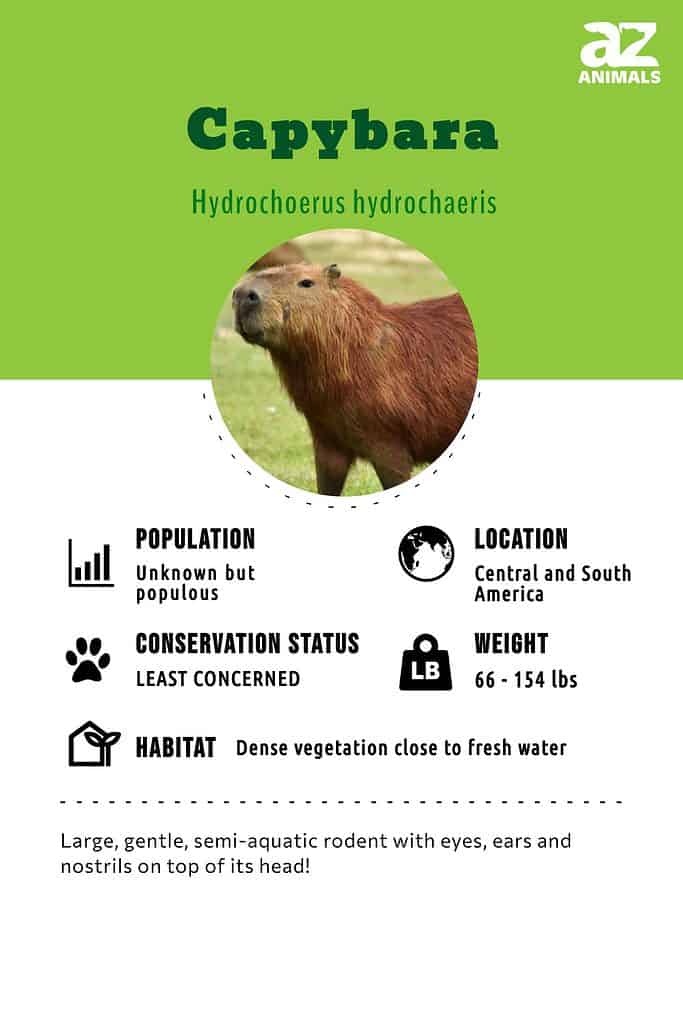
Credit: a-z-animals.com
Frequently Asked Questions
Are Capybaras Rodents Or Mammals?
Capybaras are both rodents and mammals. “Rodent” is their order (Rodentia), and “mammal” is their class (Mammalia).
Do Capybaras Lay Eggs?
No, capybaras do not lay eggs. Like all mammals (except a few like the platypus), they give live birth.
Can Capybaras Live Alone?
While capybaras can survive alone, they are social animals and prefer living in groups. Being alone makes them stressed and more vulnerable.
What Do Baby Capybaras Eat?
Baby capybaras start with mother’s milk and quickly add grass and soft plants to their diet. By one week old, they eat the same foods as adults.
Are Capybaras Dangerous To Humans?
Capybaras are generally gentle and shy. They rarely bite. However, like any wild animal, they can defend themselves if threatened.
Capybaras are true mammals, showing all the classic traits from fur to live birth. Their unique lifestyle and gentle nature make them one of the world’s most interesting animals. If you see one, you can be sure—it’s not a pig, not a reptile, but a remarkable mammal.


